
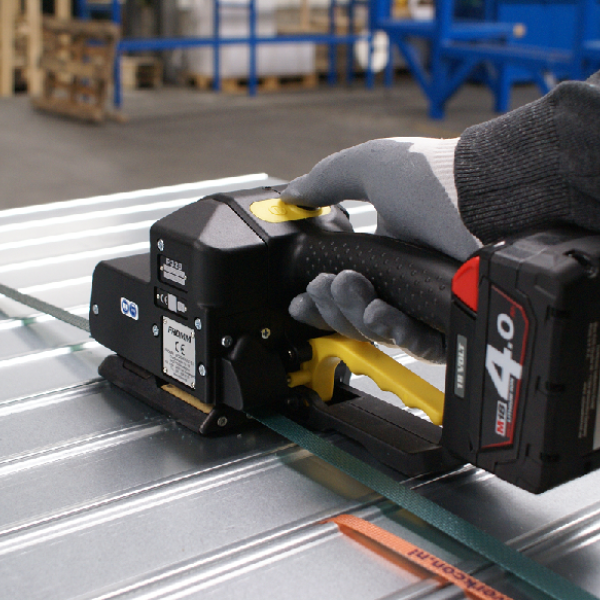


Most procurement teams treat handheld strapping tools like a consumable. Pick a price point, order a few units, and move on. That works fine until an operator flags inconsistent tension on a lumber bundle, a tool goes down mid-shift, or you are waiting three weeks for a replacement part that nobody thought to stock.
The reality is that handheld strapping tools are a control point on your packaging line. They determine whether loads leave your facility secure and consistent, whether operators can sustain their pace across a full shift, and whether your maintenance team is reacting to failures or preventing them.
The wrong tool choice creates three predictable problems:
- Inconsistent strap tension - under-tensioned straps shift in transit; over-tensioned straps can damage product or snap. Both increase damage claims and rework.
- Operator fatigue and complaints - manual tools require 25 to 40% more physical effort per strap than battery-powered equivalents, and that gap compounds across hundreds of cycles per shift.
- Unplanned downtime - a tool that is not matched to the strap type, duty cycle, or application will wear faster, fail sooner, and take the line down at the worst possible time.
The good news is that all three are avoidable. The selection criteria and maintenance practices that prevent them are not complicated. They just need to be applied before the purchase order is signed, not after.
Manual vs Battery Handheld Strapping Tools: Which One Fits the Job?
The manual versus battery debate is not really about technology preference. It is about matching the tool to the actual workload. Both have a legitimate place in industrial and lumber operations. The question is which one fits yours.
| Manual Tools | Battery Tools | |
|---|---|---|
| Best use case | Low-volume, intermittent strapping; secondary or backup applications | High-throughput, daily production strapping across multiple shifts |
| Strengths | Lower upfront cost, no battery management, simple mechanics | Consistent tension, faster cycle times, significantly lower operator fatigue |
| Tradeoffs | Higher physical effort, more operator variability, slower on volume | Higher purchase price, battery maintenance required, more complex settings |
| Buying signal | Under 50 straps per shift, infrequent use, budget-constrained | 100+ straps per shift, repetitive tasks, operator fatigue is a concern |
Manual tools still hold roughly 41% of the strapping tools market by volume in 2026, primarily because they are cost-effective for smaller or less frequent applications. They are not obsolete. But they are not the right call for a lumber plant running multiple shifts and strapping hundreds of bundles a day.
Battery-powered tools handle 200 to 400 straps per day per tool under normal production conditions. They automate tensioning, sealing, and cutting, which reduces the repetitive hand and wrist force that leads to musculoskeletal strain over time. Operations that have switched from manual to battery tools report an average 22% increase in daily output per operator, not because the operators are working harder, but because they are working more consistently with less fatigue drag.
The practical rule: if operators are strapping more than 100 loads per shift on a regular basis, battery tools are not a luxury. They are the lower total-cost option once you factor in output consistency, fatigue-related slowdowns, and the downstream cost of variable tension.
What to Evaluate Before You Buy
Spec sheets are a starting point, not a buying decision. Here is the evaluation sequence that actually matters for lumber and industrial packaging applications.
1. Strap Compatibility First
Start with the strap you run, not the tool you want. Confirm the strap material (PET or PP), width, and thickness against the tool's rated range. The FROMM P328S, for example, handles 12 to 16 mm wide PET/PP strap at 0.4 to 1.05 mm thickness, while the P329S steps up to 16 to 19 mm PET at 0.65 to 1.35 mm. Running strap outside a tool's rated range accelerates wear on feed wheels and tensioning components and produces inconsistent joints.
2. Tension Force and Speed vs Your Load Profile
Match the tool's tension range to what your loads actually need. A tool rated to 4,000 N gives you headroom for dense lumber bundles; a tool capped at 2,500 N may be adequate for lighter industrial cartons. Tension speed matters too: faster tensioning (up to 220 mm/sec on some models) reduces cycle time on high-volume lines.
3. Weight, Grip, and Interface
Battery tools in the 12 to 19 mm class cluster between 3.8 and 4.3 kg. That 500-gram spread may seem minor, but across 300 strapping cycles per shift, it is not. Evaluate grip design, balance with battery attached, and whether the interface (mechanical knobs vs touchscreen) suits your operators and environment. Touchscreen models offer programmable settings that improve repeatability, but they require more operator training and are more sensitive to harsh environments.
4. Serviceability and Local Support
This is the criterion most buyers underweight. Ask your supplier: How long does a repair take? Are wear parts stocked locally? What is the warranty coverage on the battery and tool body? These are not edge-case questions. In Canada, service response time and parts availability vary significantly by supplier - and a tool that takes four weeks to service is a more expensive tool than its price tag suggests. Most suppliers will service their own tools. Fewer will stock the parts to do it quickly, and fewer still will touch a competitor's equipment. Fromm Packaging Canada is one of the exceptions - FROMM service centre repairs all brands of strapping tools, carries a large inventory of spare parts on-site, and turns most repairs around in 3 to 5 business days. That kind of cross-brand repair capability matters when your floor runs mixed equipment, or when you are transitioning between tool generations and cannot afford a gap in service coverage.
Questions to ask any supplier before committing:
- What is the typical repair turnaround for this model?
- Are feed wheels, tensioning wheels, and batteries stocked locally?
- What does the recommended maintenance interval look like for our duty cycle ?
The Overlooked Cost: Ergonomics, Fatigue, and Strap Tension Consistency
Ergonomics rarely shows up on a procurement checklist. It should. As one industry occupational health report put it: "Poor ergonomics leads to slower work and more packaging failures, directly impacting throughput and damage rates."
That is not a soft HR concern. It is a production output issue.
What operators notice first when a tool is a poor ergonomic fit:
- Wrist and shoulder fatigue within the first hour of a shift
- Inconsistent joint quality as fatigue accumulates across the day
- Slower pace on the second half of a shift compared to the first
- Higher error rates and tension variability between operators
The strap tension consistency problem is closely related. A fatigued operator applies less consistent force. A tool with worn tensioning components drifts from its set point. A battery at 20% charge may not deliver the same tension as one at 80%. All three factors compound, and the result shows up as variable strap tightness across a pallet or bundle, which can mean shifted loads, damaged product, or failed shipments.
Battery tools address the fatigue side of this directly by automating tensioning and sealing. But they only deliver consistent tension when the tool settings are matched to the strap and package, the battery is maintained, and the tensioning components are inspected regularly.
The lesson: buying a battery tool does not automatically solve the consistency problem. Matching the tool settings to the application, training operators on the interface, and keeping the tool in calibration are what actually close the gap.
Portable Strapping Tool Maintenance: What Prevents Downtime
Preventive maintenance for strapping tools is not complicated. The plants that do it consistently see dramatically fewer line-stopping failures. Research on industrial equipment maintenance shows predictive and preventive programs reduce unplanned breakdowns by up to 75% and cut downtime by 35 to 45%. The same logic applies directly to handheld strapping tools.
Over 50% of strapping tool maintenance issues trace back to debris and contamination in the feed and tensioning mechanism. A daily cleaning habit eliminates the majority of those failures before they start.
Here is a practical maintenance schedule for battery-powered handheld strapping tools, calibrated to production intensity:
| Frequency | Task |
|---|---|
| Per shift / Daily |
|
| Weekly |
|
| Monthly |
|
| Semi-annually / Annually |
|
Battery Care Is Not Optional
Battery condition directly affects tension output. A degraded battery delivers less consistent power to the tensioning motor, which means strap tension drifts even when the tool settings have not changed. Charge batteries according to the OEM schedule, avoid storing them fully discharged, and replace them on a cycle-count basis rather than waiting for visible failure.
The P328S and P329S from FROMM, for example, use 18V / 4.0Ah Li-Ion batteries rated for approximately 900 cycles per charge on the standard battery, scaling to 1,800 cycles with the extended 9.0Ah option. Tracking charge cycles and planning replacements accordingly keeps tension output predictable.
How to Reduce Industrial Strapping Tool Repair Downtime
When a tool does go down, the difference between a 20-minute recovery and a two-day production gap usually comes down to preparation, not luck.
The industry is shifting away from a run-to-failure approach toward scheduled maintenance and planned response. As one maintenance expert put it: "Less surprise failure in the middle of a high-volume shift leads to better planning for when tools go offline." That shift starts before the first tool is purchased.
A practical downtime response plan:
- Standardize tool classes across your operation. Running two or three strap sizes on a single tool class simplifies spare parts, operator training, and service logistics. Every additional tool model you introduce adds complexity to your parts inventory and repair process.
- Stock common wear parts on-site. Feed wheels, tensioning wheels, and strap guides are the highest-turnover components. Having one set on the shelf means a 30-minute swap instead of a three-week wait.
- Keep at least one backup battery per active tool. Battery failure mid-shift is the most common cause of unplanned stops on battery-powered tools. A spare battery costs a fraction of the downtime it prevents.
- Track failures by tool, operator, and strap type. If one tool fails repeatedly, the issue may be application mismatch, operator handling, or a maintenance gap, not a defective unit. You cannot identify the pattern without the data.
- Build service response into the buying decision. Confirm local repair availability and parts stocking before you commit to a tool.
Downtime is a procurement decision. The tools that are easiest to service, with parts available locally and a supplier who responds quickly, will always outperform a cheaper alternative that sits idle waiting for repair.
A Practical Buying Framework for 2026
Before signing off on any handheld strapping tool purchase, run it through this five-point scorecard:
- Application fit: Does the tool handle your strap material, width, and thickness? Is the tension range matched to your load profile?
- Duty cycle match: Can the tool sustain your daily cycle count without overheating or excessive wear? Are the cycles-per-charge specs realistic for your shift length?
- Ergonomics and operator adoption: Have operators handled the tool under real conditions? Does the weight, balance, and interface work for the people using it?
- Total operating cost: Have you factored in battery replacement, wear parts, and service frequency, not just the purchase price?
- Serviceability: Is local repair support available? Are parts stocked? What is the realistic turnaround when something breaks?
A tool that scores well on all five is the right tool, regardless of brand. One that scores well on price and poorly on the other four will cost more over its service life than a better-matched option would have upfront. .jpeg?width=378&height=396&name=STRAPPING%20TOOL%20CHECKLIST%20(1).jpeg)
The global strapping devices market is growing toward US$8.1 billion by 2033. The plants that get ahead of that curve are the ones treating tool selection and maintenance as a production discipline, not a purchasing afterthought. Operations that outgrow handheld tools entirely often move to automated strapping systems or pair them with stretch wrapping machines for full end-of-line control.
If you are evaluating handheld strapping tools for a lumber or industrial packaging operations in Canada. Contact us to work through the right tool setup and maintenance approach for your specific application.
