


Picture this: a warehouse supervisor wraps 12 pallets before lunch, every day, without thinking twice about it. The stretch film is cheap. The process is familiar. Nobody is complaining.
So why does it feel like the shipping budget never quite adds up?
The answer is not on any single invoice. Manual pallet wrapping hides its real cost across four separate buckets: labour time, excess film use, load damage, and the quiet drag of worker fatigue. None of them look alarming on their own. Together, they tell a different story.
The real problem: hand wrapping does not feel expensive because the costs are scattered. Once you add them up, the math often surprises people.
This post will show you three things:
- What manual wrapping is actually costing your operation right now
- How the FROMM FS1000 semi-automatic stretch wrapper changes those numbers
- The simple daily volume threshold where upgrading stops being a capital expense and starts being the more conservative financial decision
That threshold is roughly 12-15 pallets per day. If you are already there, keep reading.
What Hand Wrapping Actually Costs
Most operations track film spend. Very few track the full picture. Here is what manual wrapping actually costs when you look at all four buckets together.
|
Cost Type |
What Causes It |
Why It Grows Quietly |
|---|---|---|
|
Labour time |
Manual wrapping takes 3-5 minutes per pallet |
At 12 pallets/day, that is roughly $5,000-$6,500 in annual labour cost before any overtime |
|
Excess film |
Operators over-wrap corners, leave gaps, or apply inconsistent tension |
Manual wrapping typically uses 20-30% more film than necessary, adding $300-$500 per year at 250 pallets/month |
|
Load damage |
Inconsistent wrap tension leads to load shifting in transit |
A 2-3% damage rate is common with manual wrapping, and it often gets blamed on the carrier instead of the wrap |
|
Worker fatigue |
The 12th pallet of a shift does not get the same care as the first |
Quality becomes a variable tied to energy levels, not a repeatable standard |
The lesson: none of these line items look like a crisis. But at 12 pallets per day, you are likely spending more than $6,000 annually in labour alone, before you factor in film waste and damage costs on top.
That is not a small number. And it compounds every year you stay manual.
The other issue is control. When wrap quality depends on who is on shift and how tired they are, load consistency becomes unpredictable. That unpredictability has a cost too, even if it never shows up as a line item.
Why the FS1000 Changes the Economics
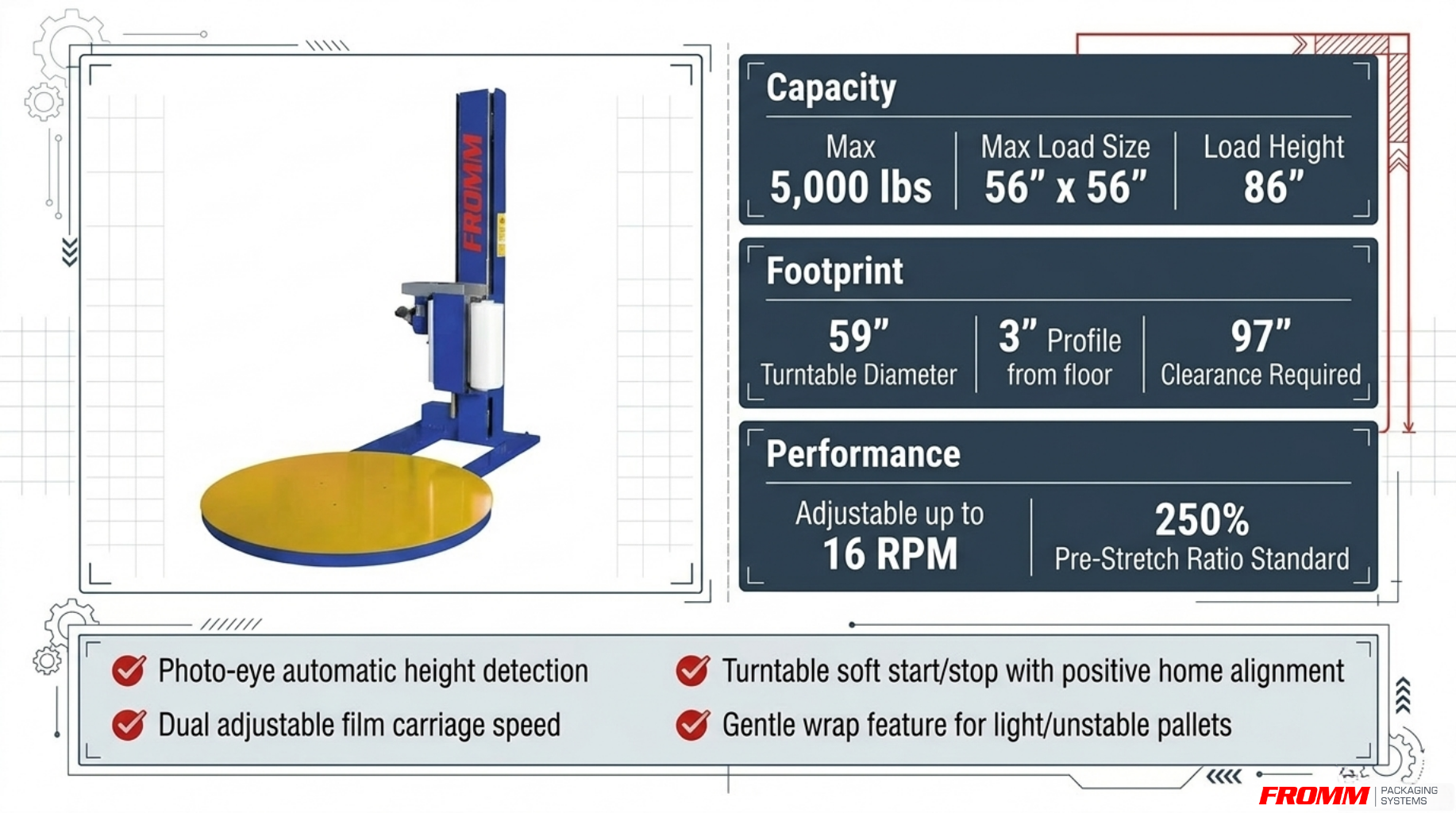
The FROMM FS1000 semi-automatic turntable wrapper does not just wrap faster. It removes the variables that make manual wrapping expensive.
Here is how each feature translates into a real operational outcome:
- Wrapping time drops to 60-90 seconds per pallet. A task that took 3-5 minutes of active operator time becomes a consistent machine cycle. At 400 loads per week, that is roughly 7 hours of labour saved every week.
- The X-TRETCH carriage delivers 250% film pre-stretch as standard. More stretch per metre of film means less film used per pallet. Pre-stretch systems can use up to 60% less material than hand wrapping. That $300-$500 in annual film waste largely disappears.
- Electronically adjustable film tension and automatic corner compensation standardize every load. The machine applies consistent containment force regardless of pallet shape, load weight, or who is operating it. Photo-eye automatic height detection means the wrap profile adjusts to each load without manual input.
- The gentle wrap feature and low-profile design protect both the product and the operator. Eliminating the physical walk-around reduces repetitive strain and frees your team for higher-value tasks.
- 5,000 lb load capacity, 86-inch load height, 59-inch turntable. Built for real warehouse conditions, not just light-duty applications.
The lesson: the FS1000 does not just speed things up. It removes operator variability from the equation entirely. Every pallet gets the same wrap, every time, regardless of shift, fatigue, or experience level.
That consistency is where the real savings accumulate. Fewer damage claims. Less film waste. Less time. Less risk.
The 12-15 Pallet Test: Simple ROI Math
You do not need a complex spreadsheet to know whether upgrading makes sense. You need three numbers.
Step 1: Estimate your annual labour cost for wrapping. (Daily pallets x minutes per pallet x hourly labour rate x working days)
Step 2: Add your estimated annual film waste. (If operators are wrapping manually, assume 20-30% more film than a machine would use)
Step 3: Add any damage-related costs from load shifting or rework in the past year.
Compare that total against the cost of an entry-level semi-automatic wrapper. Then calculate your payback period in months.
Worked example: 12 pallets per day
- Labour: 12 pallets x 4 minutes x $25/hr x 250 days = $5,000/year
- Excess film waste: estimated $400/year
- Damage-related costs (conservative): $600/year
- Total annual hidden cost: ~$6,000
At that volume, most operations see payback on an entry-level semi-automatic wrapper within 18-24 months. After that, the savings are pure.
The conclusion is straightforward. If your operation is already wrapping 12-15 pallets per day, staying manual is not the cautious choice. It is the more expensive one.
The tipping point is not about volume for its own sake. It is about the point where the accumulated hidden costs of manual wrapping start to exceed the annualized cost of a machine. For most operations, that point arrives earlier than expected.
Beyond the Numbers: What Better Wrapping Fixes Downstream
The ROI math is the starting point. But there are operational benefits that do not show up cleanly in a payback calculation, and they matter just as much.
- Consistent loads mean fewer receiving headaches. When every pallet arrives properly contained, you reduce friction at the customer's dock. That consistency builds credibility with trading partners over time.
- Standardized wrapping removes dependence on individual operators. With a machine, wrap quality does not vary based on who is on shift, how experienced they are, or how far into the day it is. The process becomes repeatable by design.
- The machine becomes more valuable as your volume grows. Manual wrapping has a ceiling. As throughput increases, it becomes a bottleneck. A semi-automatic wrapper scales with your operation without adding headcount.
- It is a safety improvement, not just a productivity one. Repetitive walking, bending, and reaching around pallets is a known source of workplace strain. Automating the process removes that exposure entirely.
The lesson: this is not just a cost-reduction decision. It is a process control decision. And for operations that expect volume to grow, it is also a future-proofing move.
Start With Your Current Cost, Not the Machine Price
Before you look at equipment pricing, run the numbers on what you are already spending.
Ask yourself four questions:
- How many pallets does your operation wrap per day?
- How long does each wrap take, and what is your labour rate?
- How much film are you buying monthly, and how much of that is waste?
- Have you had any load damage claims or rework costs in the past year?
If your daily pallet count is at or above 12-15, the answer is almost always the same. The hidden cost of staying manual is already higher than the annualized cost of a machine. You are not avoiding a spend. You are deferring savings.
The FROMM FS1000 is built for exactly this volume range. Semi-automatic, Entry - Level, and practical for real production environments.
See the full specs and find out if the FS1000 fits your operation.
View the FS1000 on the FROMM website