
Most facilities don't think about their strapping machine until something goes wrong. A load shifts on the truck. A pallet collapses in the warehouse. A damage claim lands on your desk.
By then, the wrong equipment has already cost you.
Choosing the right strapping machine is one of the most consequential packaging decisions you'll make. It affects every shipment that leaves your facility, every hour your team spends on the line, and every dollar you spend on materials and labour. Get it right and your operation runs smoother, faster, and safer. Get it wrong and you're dealing with load failures, wasted strap, and downtime you can't afford.
This guide walks you through the full picture: machine types, strapping materials, automation levels, throughput matching, and what to look for in a supplier who'll still be supporting you five years from now.
This guide walks you through the full picture: machine types, strapping materials, automation levels, throughput matching, and what to look for in a supplier who'll still be supporting you five years from now.
Key Takeaways
- Strapping machines come in three types: handheld tools, semi-automatic machines, and fully automatic inline systems.
- Your strapping material choice (PP, PET, or steel) depends on load weight, transit conditions, and product characteristics.
- Match automation level and machine speed to your daily throughput and available labour.
- Total cost of ownership matters more than purchase price — factor in maintenance, parts, and downtime.
- Local service capability is not a nice-to-have. It's a requirement.
What Is a Strapping Machine and How Does It Work?
A strapping machine is industrial equipment that applies a strap which is plastic or metal around packages, boxes, bundles, or pallets. It secures items together for storage and transport, preventing shifting, falling, or damage during handling.
The process follows the same sequence every time:
- The strap feeds around the load, automatically or with operator assistance.
- The tensioning mechanism pulls the strap tight to create a firm grip.
- The sealing system bonds the strap ends together using heat welding, friction welding, or metal seals.
That's it. Simple in principle. The complexity is in matching the right machine to your specific operation.
Modern strapping equipment ranges from handheld battery-powered tools for mobile applications to fully automated inline systems integrated with conveyor lines. The level of automation you need depends on your production volume, package consistency, and available labour. Each step up in automation delivers more speed and consistency but requires more upfront investment and a more predictable package environment to work well.
Why Strapping Machines Matter More Than Most Operations Realise
Manual strapping is the default in a lot of facilities. It's familiar. It requires no capital investment. And it works, until it doesn't.
The real cost of manual strapping isn't the labour. It's the inconsistency. Tension varies by operator, by shift, by fatigue level. One under-tensioned strap on a heavy pallet is all it takes for a load failure. And load failures are expensive: damaged product, freight claims, customer relationships, and the time it takes to sort it all out.
Here's what proper strapping equipment actually solves:
Load Security
Strapping holds items together as a single stable unit. It prevents individual boxes from shifting on pallets and protects products from the vibration and impact of road, rail, or ocean transport. A properly strapped load maintains its integrity from your dock to the customer's receiving area.
Operational Speed
Even a basic semi-automatic machine applies straps in seconds with uniform tension. High-speed automatic systems reach 30 to 65 straps per minute. That's not incremental improvement — it's a different category of throughput.
Labour Efficiency
One operator can manage multiple strapping machines. Machines apply straps more precisely and consistently than manual methods, reducing material waste. The labour savings alone often justify the investment within the first year.
Worker Safety
Repetitive bending, reaching, and pulling from manual strapping creates real ergonomic risk over time. Strapping machines eliminate most of that physical demand. This matters not just for your team's wellbeing, but for your WCB claims and long-term staffing stability.
The Three Types of Strapping Machines
Strapping machines fall into three categories based on automation level. Each fits a different operational profile.
Handheld and Manual Strapping Tools
Handheld tools are portable devices where the operator wraps the strap around the load manually. The tool handles tensioning and sealing. Battery-powered versions automate those functions with a button press. Pneumatic tools use compressed air for heavier applications.
These are the right choice when:
- Strapping volumes are low (under 50 straps per hour)
- Load sizes vary significantly and don't fit a fixed machine
- You need mobility — on the dock, in the yard, at customer sites
FROMM's battery-powered strapping tools include touchscreen interfaces and ergonomic designs built to reduce operator fatigue during extended use. The portability is real. So is the precision.
Semi-Automatic Strapping Machines
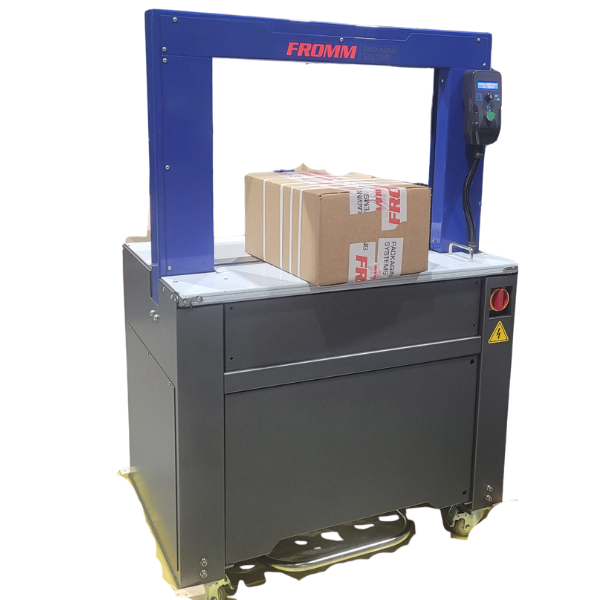
Semi-automatic machines require an operator to position the package and initiate the cycle. The machine then tensions the strap to a preset level, seals the ends, and cuts for the next cycle. Most semi-automatic units deliver 10 to 15 straps per minute.
These machines suit medium-volume operations and environments where package sizes vary. They cost significantly less than fully automatic systems and integrate into existing workflows without major facility changes. Tabletop models are particularly practical for compact packaging areas.
The lesson: semi-automatic is often the right answer for operations that think they need to choose between "manual" and "fully automated." It's the middle ground that delivers real ROI without the complexity.
Fully Automatic Strapping Machines
Fully automatic machines handle the entire process without operator intervention. Sensors detect the package, trigger the strapping cycle, and release the load. Inline systems integrate directly with conveyor lines for continuous high-speed operation.
Automatic machines reach 30 to 65 straps per minute. They're designed for high-volume operations with consistent package dimensions. The upfront investment is higher, but the labour savings and throughput gains compound quickly at scale.
The requirement here is consistency. Automatic systems perform optimally when package dimensions are predictable. Variable loads create feed and cycle problems that erode the speed advantage.
Choosing Your Strapping Material: PP, PET, or Steel
The machine is only half the decision. The strap matters just as much. Three materials dominate industrial applications, and each serves a different load profile.
Polypropylene (PP): The Everyday Workhorse
PP is the most economical option. It handles light to medium-duty applications well and works with both manual tools and automatic machines. It's flexible, easy to use, and resistant to rust and temperature variation.
Use it for: bundling boxes, securing cartons for retail distribution, general warehouse packaging.
Polyester (PET): The Right Choice for Demanding Loads
PET offers higher tensile strength than PP and handles loads above 400 kg. More importantly, PET has elongation recovery , it stretches under impact and returns to tension. That property is critical for loads that shift or settle during transport.
PET is particularly valuable for lumber, building materials, and products that change dimension due to moisture or compression. It also performs reliably in outdoor storage conditions where UV exposure and moisture would degrade PP over time.
The lesson: if your loads exceed 400 kg, move outdoors, or involve products that compress or settle, PET is the correct choice. PP is not a cost-saving measure in those situations, it's a liability.
Steel: When Nothing Else Will Do
Steel strapping delivers the highest tensile strength available. It doesn't stretch, which makes it ideal for extremely heavy, rigid loads that won't compress or settle: metal coils, concrete products, large machinery.
The tradeoffs are real. Steel requires specialised tools, creates safety considerations around sharp edges, costs more per foot than plastic, and adds weight to shipments. Use it only when load requirements genuinely demand it.
How to Match a Strapping Machine to Your Operation
This is where most buyers go wrong. They look at features and price before they've properly defined what their operation actually needs. Start here instead.
Step 1: Calculate Your Throughput
How many straps do you apply per hour? Per day?
- Under 50 straps/hour: handheld tools are likely sufficient
- 50 to 200 straps/hour: semi-automatic machines are the right fit
- 200+ straps/hour: evaluate fully automatic systems
Don't just calculate today's volume. Think about where you'll be in two to three years. Buying slightly more capacity now is almost always cheaper than a forced upgrade later.
Step 2: Assess Your Package Dimensions
Package size affects your selection in two ways. First, the machine must physically accommodate your largest packages, arch-style machines have fixed opening dimensions. Second, package consistency determines whether automatic systems are practical at all.
If your operation handles highly variable sizes, semi-automatic or handheld tools offer the flexibility you need. Automatic systems are built for predictability.
Step 3: Audit Your Floor Space
Strapping machines range from compact tabletop units to large inline systems. Measure your available area and map how the machine integrates with existing conveyors, workstations, and material flow. Vertical strapping machines have a smaller footprint than horizontal arch systems, a real consideration in tight facilities.
Step 4: Run the Labour Numbers
Labour is often the deciding factor between semi-automatic and fully automatic equipment. If finding and retaining packaging staff is difficult — and in most Canadian markets right now, it is automated systems reduce that dependency directly.
Calculate the labour cost per strap for each option. The math usually makes the decision clear.
What Features Should You Look for in a Strapping Machine?
Beyond basic functionality, several features distinguish high-quality strapping machines from basic models. These capabilities affect performance, reliability, and long-term value.
Adjustable Tension Control for Different Applications
The ability to adjust strap tension is critical for handling different products. Fragile items need lower tension to prevent crushing, while heavy pallets require maximum tension for security. Look for machines with easy-to-adjust tension settings and consider electronic controls for precise repeatability.
Strap Width and Material Compatibility
Verify that the machine supports the strap widths and materials you plan to use. Some machines handle only polypropylene, while others work with both PP and PET. Wider straps generally offer more strength but require compatible equipment. Having flexibility to change strap types as your needs evolve adds long-term value.
Sealing Method and Joint Strength
Strapping machines use different sealing methods: heat sealing, friction welding, or metal seals. Heat and friction sealing eliminate the need for separate seal inventory and create strong joints with plastic strapping. The seal strength should match or exceed the strap's break strength for reliable performance.
Durability and Construction Quality
Industrial strapping machines operate in demanding environments. Look for machines built with quality materials, accessible components for maintenance, and proven reliability records. FROMM Packaging Canada's equipment reflects Swiss engineering standards with precision manufacturing and robust construction designed for years of dependable service.
How Do Strapping Machines Serve Small Packaging Teams?
Small packaging teams face unique challenges when selecting strapping equipment. You need reliability and efficiency without the complexity of large automated systems. The right equipment multiplies your team's productivity without requiring specialized technical skills to operate.
Tabletop Machines for Compact Workspaces
Tabletop semi-automatic strapping machines fit into existing packaging areas without major facility modifications. These machines position at standard work height, allowing operators to stand comfortably while strapping packages. Cycle times of two to three seconds per strap significantly outpace manual methods.
The investment in a tabletop machine often pays back quickly through labor savings and reduced material waste. Small teams gain consistent strapping quality without dedicating a full-time operator to the task.
Battery-Powered Tools for Flexibility
Battery-powered strapping tools give small teams mobility and flexibility. Operators can strap loads anywhere in the facility, on the dock, in storage areas, or at customer locations. Modern lithium-ion batteries last through full shifts, and quick-change battery systems minimize downtime.
FROMM's Smart S Series battery tools feature touchscreen interfaces that simplify operation and allow quick adjustment between different strap types and tension settings. These tools combine automation benefits with the portability that small operations often need.
What Should High-Throughput Operations Consider?
High-volume logistics and manufacturing facilities require strapping solutions that keep pace with production demands. Equipment selection focuses on speed, reliability, and integration with automated material handling systems.
Inline Integration with Conveyor Systems
Fully automatic inline strapping machines integrate directly with conveyor systems. Packages flow continuously through the strapping station without operator handling. Sensors detect each package, trigger the strapping cycle, and release the load—all without stopping the line.
This integration eliminates the labor bottleneck in packaging operations. A single operator can oversee multiple strapping stations, intervening only to reload strap coils or address occasional jams.
High-Speed Strapping Heads for Maximum Output
High-speed strapping machines use advanced strapping heads capable of 60 or more cycles per minute. These systems require quality strapping material with consistent dimensions to maintain reliable feed and seal quality at speed.
FROMM Packaging Canada offers automated strapping systems designed for demanding industrial environments. These machines deliver consistent performance cycle after cycle, backed by local technical support and spare parts availability.
Redundancy and Uptime Considerations
For critical production lines, consider redundancy in your strapping equipment. A single machine failure shouldn't shut down your entire operation. Some facilities install backup strapping stations or keep configured spare strapping heads available for quick changeover.
How Do Mixed Pallet Sizes Affect Equipment Selection?
Operations that handle mixed pallet sizes and varying load configurations need strapping solutions that adapt to different requirements without constant reconfiguration.
Adjustable Arch Dimensions for Varying Loads
Arch-style strapping machines come in different sizes to accommodate various load dimensions. If your pallets vary significantly in height or width, you may need a machine with the largest arch that fits your space—or consider multiple machines optimized for different size ranges.
Some advanced systems feature automatic arch positioning that adjusts to each load. These machines cost more but eliminate manual adjustments and reduce cycle time for mixed-load operations.
Programmable Settings for Different Products
Modern strapping machines store multiple programs for different product configurations. Operators select the appropriate program, and the machine automatically adjusts tension, strap position, and cycle parameters. This capability speeds changeovers and ensures consistent strapping across product variations.
Mobile and Portable Solutions
For operations where fixed machines can't reach all strapping locations, mobile strapping solutions fill the gap. Portable strapping machines on wheels can move between workstations, while handheld tools handle one-off or irregular loads that don't fit standard machine configurations.
What Role Does Maintenance Play in Strapping Machine Performance?
Proper maintenance keeps strapping machines running reliably and extends equipment life. Establishing maintenance routines prevents unexpected breakdowns that disrupt production.
Daily Cleaning and Inspection Practices
Daily maintenance starts with cleaning the strap path and removing debris that can cause feeding problems. Inspect the machine for loose components, unusual noises, or signs of wear. Test tension and sealing functions before starting production to catch issues early.
These simple daily checks take only a few minutes but prevent many common problems. Operators should be trained to recognize early warning signs of developing issues.
Scheduled Preventive Maintenance
Most strapping machines benefit from professional service every 6 to 12 months, depending on usage intensity. High-volume operations may require quarterly maintenance. Scheduled service includes lubricating moving parts, adjusting tension mechanisms, inspecting wear components, and calibrating control systems.
Working with a supplier that offers service programs—like FROMM's strapping tool repair and maintenance services—ensures your equipment receives expert attention and genuine replacement parts.
.jpeg?width=1414&height=1482&name=STRAPPING%20TOOL%20CHECKLIST%20(1).jpeg)
Spare Parts Planning and Availability
Keeping critical spare parts on hand minimizes downtime when components wear out. Tension wheels, sealing elements, and cutting blades are common wear items. Your equipment supplier should maintain parts inventory and offer fast delivery to keep your operation running.
How Do You Evaluate Total Cost of Ownership?
The purchase price is only part of your strapping machine investment. Total cost of ownership includes operating costs, maintenance expenses, and the value of productivity gains over the equipment's useful life.
Initial Investment Versus Long-Term Value
Higher-quality machines typically cost more upfront but deliver lower operating costs and longer service life. A machine that runs reliably for 10 years with minimal maintenance may cost less overall than a cheaper alternative requiring frequent repairs and earlier replacement.
Calculate the cost per strap for each option you're considering. Include machine depreciation, strap material, labor, maintenance, and downtime costs for a complete picture.
Energy Consumption and Operating Costs
Modern strapping machines vary in energy efficiency. Look for machines with energy-saving features like standby modes and efficient motor designs. For high-volume operations, energy costs add up over time and deserve consideration in your evaluation.
Productivity Impact and ROI
The productivity improvement from upgrading strapping equipment often drives the strongest return on investment. Calculate how much time your team currently spends on strapping tasks and how much faster the new equipment will complete the same work. Labor cost savings typically pay back equipment investments quickly.
What Should You Look for in a Strapping Equipment Supplier?
our relationship with a strapping equipment supplier doesn't end at the sale. It's just starting.
The machine you buy will need service, parts, and technical support for its entire working life. The supplier who can't deliver those things quickly, from local inventory, with people who understand your equipment is a liability, not a partner.
Local Presence Is Non-Negotiable
Equipment issues don't wait for convenient times. A supplier with local presence can respond when you need it. FROMM Packaging Canada operates out of Pickering, Ontario, with inventory ready to ship and technicians available to deploy across Canada. That's not a marketing claim, it's a service model that matters when your line is down.
Technical Expertise Over Generic Sales
The right supplier asks detailed questions about your operation before recommending anything. They understand your industry, your load profile, and your constraints. If a supplier is pushing a specific machine before they've understood your throughput, package dimensions, and labour situation, that's a red flag.
Parts Availability and Service Programs
Confirm the supplier maintains spare parts inventory ,not just for popular models, but for the specific equipment you're buying. Ask about lead times on critical wear components. Lifecycle care programs that include scheduled maintenance, remote assistance, and priority parts supply protect your investment and eliminate the scramble when something wears out.
Innovation Backed by Real Engineering
A supplier invested in product development brings you access to better technology as it evolves. FROMM Packaging Canada draws on the global FROMM Group's 75+ years of packaging innovation. The Smart S Series battery tools with touchscreen interfaces are a recent example — purpose-built for operators who need precision and portability in the same tool.
Step-by-Step Process for Selecting Your Strapping Machine
Step 1: Document your current state. Count daily straps. Measure package dimensions and weights. Note available floor space, power supply, and compressed air. Flag any special requirements: outdoor use, temperature extremes, cleanliness standards.
Step 2: Define your performance targets. What does success look like? Set specific targets for throughput speed, labour utilization, and strapping quality. Build in room for growth.
Step 3: Evaluate equipment options. Based on your requirements, identify the right machine category. Request demonstrations. Test with your actual products when possible. Compare features, quality, and total cost of ownership — not just sticker price.
Step 4: Assess supplier capabilities. Service response time. Parts inventory. Technical expertise. References from similar operations. Can they support this equipment for its full useful life?
Step 5: Plan your implementation. Installation timing, operator training, maintenance program setup. Establish baseline measurements so you can track the actual improvement your new equipment delivers.
This isn't complicated. Most operations that make poor equipment decisions skip steps one and two and jump straight to step three. Don't do that.
Conclusion: Making the Right Strapping Machine Choice for Your Operation
Choosing a strapping machine in 2026 means balancing immediate needs with long-term operational goals. The right equipment secures your loads reliably, keeps pace with your throughput requirements, and delivers strong return on investment through labor savings and reduced damage claims.
Start by understanding your volume requirements, package characteristics, and available resources. Match these needs to the appropriate automation level—from handheld tools for flexibility to fully automatic systems for high-volume operations. Select strapping materials that match your load security requirements without over-engineering the solution.
Partner with a supplier who brings technical expertise, local service capability, and genuine commitment to your success. FROMM Packaging Canada combines Swiss engineering heritage with Canadian presence to deliver strapping solutions that perform reliably year after year.
Your strapping equipment decision affects every package that leaves your facility. Take the time to make this choice carefully, and your investment will pay dividends in secure loads, efficient operations, and satisfied customers.