
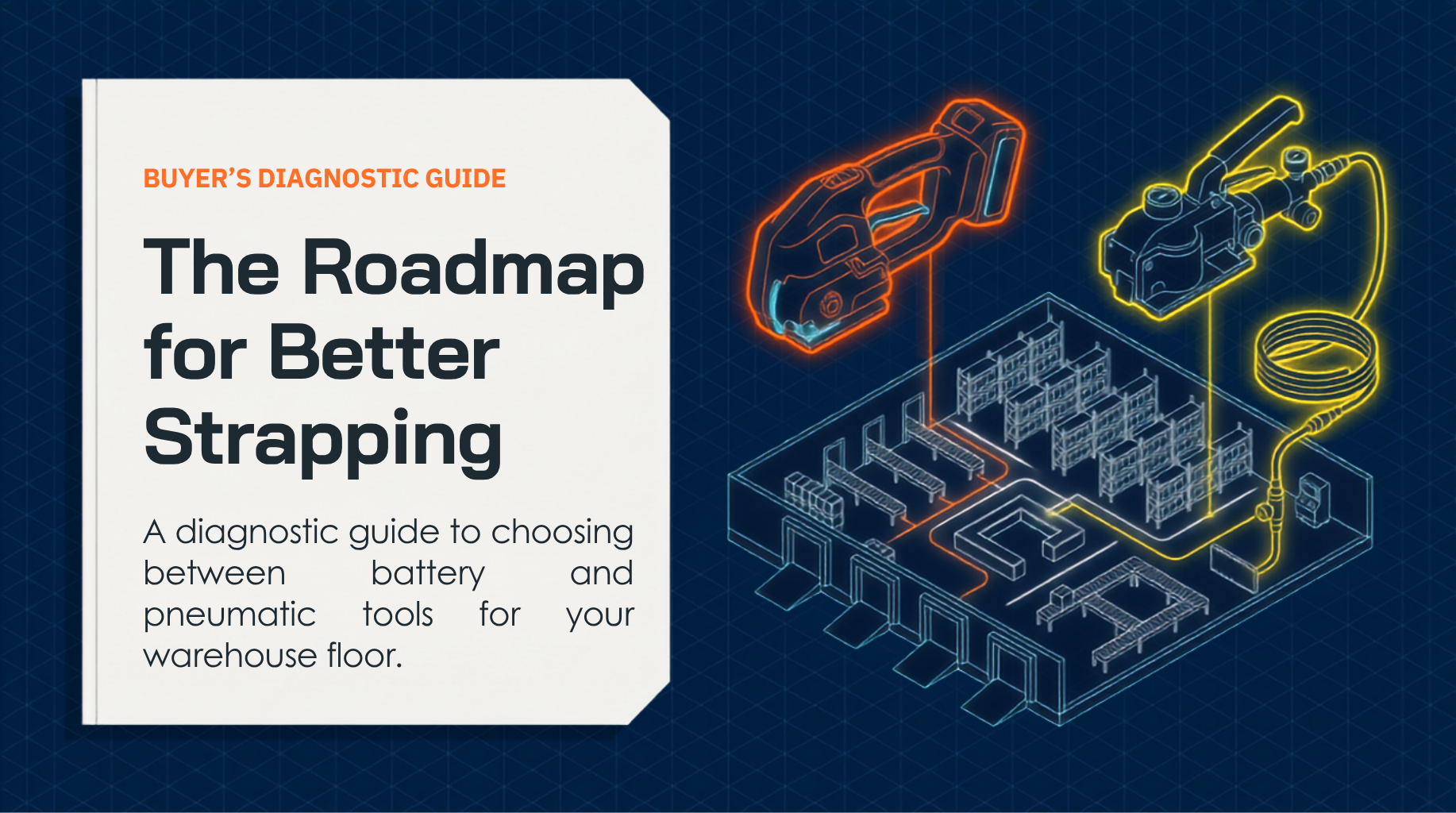


The decision between battery-powered and pneumatic strapping tools isn't just about specs on paper, it's about what actually happens on your warehouse when you're running mixed loads during peak season.
A Diagnostic Guide to choose between Battery and Pneumatic Plastic Strapping Tools
If you manage pallet strapping operations in a Canadian warehouse, you've already seen this: Packaging operators clustered around fixed workstations during peak, waiting for pallets to reach the wrap zone. Or you've got roving teams with handheld tools, moving across the floor to wherever loads are staged. Either way, the tool choice matters more than the price tag suggests.
When managers compare battery and pneumatic strapping tools, the conversation usually starts with power and speed. That's the wrong place to start.
The better question is: how does your team actually strap pallets? Do operators move across the floor, dock areas, and staging zones throughout a shift? Or does strapping happen at a fixed bench or station with compressed air already running nearby? The answer to that question matters more than any spec sheet comparison.
-
Battery plastic strapping tools are the right choice for most operations. They handle general pallet strapping with Polypro or Polyester strap, require no air infrastructure, and give operators the freedom to move.
- Pneumatic tools earn their place in fixed, high-volume stations. When a tool runs all day at one location and compressed air is already available, pneumatic delivers consistent high-tension output without battery management.
- Strap material matters too. This guide focuses on Plastic strapping Tools (Polypro and Polyester). Steel strapping applications involve different tension requirements and tool categories, so if that is your primary use case, the recommendation may shift.
Most purchasing decisions start with a spec comparison: tension force, cycle time, seal strength. Those numbers matter. But they tell you nothing about what actually slows you down on the floor.
The traditional mistake is buying based on raw capability without asking where the tool will be used, how operators move between loads, whether you have air drops at every station, and what happens when you need to train a new person mid-shift. You end up with a tool that works perfectly in the demo but adds friction in practice.
The modern framework starts with operational context.
Ask yourself:
Are operators moving to loads, or are loads moving to operators?
Do you have compressed air infrastructure already in place, or would you need to run new lines?
Are you strapping consistent full pallets at a fixed station, or mixed SKU loads staged across the floor?
How long are your shifts, and how many straps per hour are you running?
Those questions matter more than the spec sheet.
Here's what actually happens when you ignore context. You install pneumatic tools because the tension specs look better, then realize operators spend half their time managing air hoses that snag on pallet edges and stretch across aisles. Or you buy battery tools for a high-volume fixed station, then discover you're swapping batteries every 90 minutes during peak and the tool sits idle while charging. Neither scenario shows up in the brochure.
The baseline rule for strapping
For most general plastic pallet-strapping applications, polypropylene or polyester strap on mixed loads, standard retail or distribution pallets, typical warehouse throughput in a battery-powered strapping tool is the better choice. It delivers the tension you need (typically 200–600 N for plastic strap), eliminates the air hose, simplifies setup, and lets operators move freely across the floor.
Battery tools have improved significantly in the past five years. Modern lithium-ion packs deliver consistent tension through the charge cycle, runtime has extended to 300–500 straps per charge depending on strap size and tension settings, and charge times have dropped to under an hour. That's enough for most operations to run two batteries in rotation without creating downtime.
But, and this matters, battery tools are not universally better. They are better for mobile operations, for facilities without existing compressed air infrastructure, for applications where operator movement and flexibility matter more than continuous high-volume throughput. If your operation doesn't fit that profile, pneumatic makes sense.
The baseline rule: If your operators walk to the load, battery wins. If the load comes to the operator at a fixed station with compressed air already available, pneumatic becomes the stronger candidate.
Side by side technical anatomy
Let's talk about what changes operationally between the two systems, not just what the spec sheets claim.
|
Criteria |
Battery Strapping Tool |
Pneumatic Strapping Tool |
|---|---|---|
|
Power source |
Rechargeable Li-Ion battery |
Compressed air supply |
|
Mobility |
Fully portable, no tether |
Fixed to air hose and compressor |
|
Tension range |
~2,600–4,500 N (plastic strap) |
~4,500–8,400 N (plastic strap) |
|
Setup |
Charge battery and go |
Requires compressor and air line |
|
Maintenance |
Battery management, tool servicing |
Compressor upkeep, hose and fitting checks |
|
Noise level |
Quieter operation |
Louder, compressor noise adds to it |
|
Best-fit environment |
Mobile teams, multi-area warehouses |
Fixed stations with existing air supply |
|
Ideal strap type |
PP and PET (most plastic pallet work) |
PP and PET, heavier-duty loads |
Battery-powered strapping tools use an onboard lithium-ion battery pack to drive a motor that tensions, seals, and cuts the strap in one cycle. The operator positions the tool, triggers the cycle, and moves to the next strap. No air hose. No compressor dependency. The tool weighs between 3.5 and 5.5 kg depending on battery size and strap width capacity. Runtime varies with strap tension and width, but modern tools typically deliver 300–500 straps per charge on 12–16 mm polypropylene strap at medium tension. Charge time runs 45–90 minutes depending on battery capacity. Maintenance involves keeping the sealing mechanism clean, replacing wear parts like the tension wheel and seal head, and managing battery health over time.
Pneumatic strapping tools use compressed air (typically 5–7 bar operating pressure) to drive the tensioning and sealing mechanisms. The operator connects the tool to an overhead air drop or floor-mounted hose reel, positions the tool, and triggers the cycle. The tool itself is lighter than a battery unit,often 2.5–3.5 kg, because there's no onboard power source. Runtime is continuous as long as air supply is available. Cycle time is typically faster than battery tools, especially on high-tension applications. Maintenance involves managing air hose wear and snags, keeping moisture out of the air supply (compressed air needs to be filtered and dried), replacing seals and o-rings in the pneumatic cylinder, and maintaining the compressor and distribution system.
Ergonomically, battery tools feel heavier in the hand but eliminate the hose drag that pneumatic tools create. Pneumatic tools are lighter, but the air hose adds resistance and snag risk, especially when operators move between stations or wrap pallets in tight aisles. In practice, operator fatigue over a full shift tends to be similar, battery weight versus hose drag, but the fatigue pattern is different. Battery tools create static load fatigue from holding the weight. Pneumatic tools create dynamic fatigue from managing hose position and resistance.
For tension and seal quality, both systems deliver comparable results on plastic strapping when properly maintained. The difference is not in capability. It's in consistency and operator dependency. Battery tools deliver the same tension regardless of how the operator positions the tool or manages the cycle. Pneumatic tools can vary slightly based on air pressure fluctuations or how the operator handles the hose during tensioning. That variability is small, but it shows up when you measure strap tension across hundreds of loads.
When a Battery Strapping Tool Is the Right Choice
For most warehouse and shipping operations, a battery-powered strapping tool is the better starting point. Here is why.
Your operators move around
The single biggest advantage of a battery tool is that it goes where the operator goes. No air hose trailing across the floor, no compressor tethering the team to one corner of the dock. Operators can strap pallets at receiving, staging, and shipping without any reconfiguration.
This matters more than it sounds. CDC ergonomic guidelines for hand tools note that hoses create both handling burden and trip hazards in active work environments. In a busy warehouse, eliminating the hose is a real safety and efficiency gain.
Battery tools handle most plastic pallet strapping
Modern battery-powered strapping tools deliver tension in the 2,600–4,500 N range, which covers the vast majority of PP and PET pallet strapping applications. That is enough for general distribution, retail, and e-commerce loads. You are not giving up meaningful capability for typical pallet work.
Key point: Battery tools have closed the gap on pneumatic significantly over the last several years. For most plastic strapping jobs, the power difference is not a practical limitation.
Simpler deployment, lower infrastructure cost
Battery tools require no compressor, no air lines, and no fittings. That means:
- Faster setup when adding a new strapping station or covering a second shift
- No dependency on compressor availability or maintenance schedules
- Easier to redeploy the tool if your layout changes
For operations without existing compressed air infrastructure, the cost of adding it can be substantial. A battery tool sidesteps that entirely.
Multi-shift flexibility
With spare batteries kept on charge, a battery tool can run continuously across shifts without the compressor reliability concerns that come with pneumatic systems. Charging discipline replaces compressor upkeep as the main operational habit.
When a Pneumatic Strapping Tool Is the Better Option
Pneumatic tools are not the default choice for most buyers, but they are clearly the right choice in specific situations. If your operation fits any of the following scenarios, pneumatic deserves serious consideration.
- Your strapping station is fixed and compressed air is already available. If the tool lives at one location and the facility already runs air lines, the infrastructure cost argument for battery disappears. Pneumatic becomes the simpler, more cost-effective option.
- You strap more than 500 loads per day at that station. At high daily strap counts, pneumatic tools deliver more consistent output over long periods without the battery management overhead. The continuous high-speed performance of pneumatic tools is a genuine advantage when volume is the primary concern.
- Your loads are heavy-duty or require higher tension. Pneumatic tools reach tension ranges of 4,500–8,400 N, which is meaningful for heavier industrial loads, building materials, or applications where joint strength is critical.
- Your operation runs long shifts without interruption. Pneumatic tools are designed to function as production workhorses for continuous operation, including 24-hour environments. There is no battery to swap or charge cycle to manage.
- Noise and environment are less of a concern. In a manufacturing plant where compressor noise is already part of the ambient environment, the added noise of a pneumatic tool is rarely a deciding factor.
The common thread: pneumatic tools perform best when the operation is predictable, fixed, and high-volume.
The Buying Criteria That Actually Matter on the Floor
Most spec comparisons stop at tension range and power source. The criteria that actually drive the right decision are more operational than technical.
Facility layout
If operators walk the floor to strap pallets in multiple areas, a hose tether is a daily friction point. It limits range, creates trip risk, and slows down any task that requires repositioning. A battery tool eliminates that constraint entirely. If the tool never leaves a fixed bench, the hose is a non-issue.
Shift pattern and runtime management
Battery tools require charging discipline: spare batteries on rotation, charging stations accessible, and a plan for shift handoffs. Pneumatic tools require compressor reliability: regular maintenance, filter checks, and air-line integrity. Neither is a dealbreaker, but both require a management habit. Know which one your team is better set up to maintain.
Operator ergonomics and fatigue
This one is underweighted in most buying decisions. Research on pistol-grip power tools shows that wrist flexion and grip force significantly increase strain risk in repetitive use. Both tool types require attention to ergonomics, but pneumatic tools add hose weight and drag to the equation. Over a full shift, that adds up.
The practical checklist before you buy:
- Where does strapping happen? One fixed station or multiple areas?
- How many straps per shift? Light-to-medium volume or 500+?
- Is compressed air already available at the strapping location?
- What strap material and width are you running? PP, PET, or steel?
- How long are operator shifts, and how physically demanding is the rest of the role?
Answer those five questions honestly and the right tool usually becomes obvious.
Our Recommendation for Most Buyers
Here is the clearest way to frame the decision:
|
Choose Battery |
Choose Pneumatic |
|
|---|---|---|
| Layout |
Mobile, multi-area strapping |
Fixed station |
| Volume |
Light to medium daily strap count |
500+ straps per day |
| Infrastructure |
No compressed air available |
Air supply already in place |
| Strap Type |
PP or PET, standard pallet loads |
PP or PET, heavier-duty or high-tension loads |
| Shift Type |
Variable shifts, multiple operators |
Long continuous shifts, one station |
For the majority of general warehouse and distribution operations, battery is the right call. It covers the tension requirements for standard plastic pallet strapping, removes infrastructure dependency, and gives operators the mobility to work efficiently across the floor.
Pneumatic is not the wrong answer. It is the right answer for a specific context: fixed, high-volume, compressed-air-ready, and long-shift environments where continuous output matters more than portability.
One more note on strap material: if your application involves steel strapping rather than plastic, the tool categories and tension requirements are different. A specialist review of your application is the right starting point before selecting a tool.
Match the Tool to Your Application
The right strapping tool is not the most powerful one. It is the one that fits your strap material, load profile, shift volume, and work environment without adding unnecessary complexity for your operators.
If you are still weighing the options or have an application that does not fit neatly into either category, a short conversation with a packaging specialist can save a costly mismatch.
Request a demo or speak with a FROMM packaging specialist to get a recommendation based on your specific operation.